
Why Raising Capital Isn’t About the Pitch
And What Investors Evaluate Instead
If investors say they love your vision but still pass, this article explains what’s really happening—and how to fix it.
Listen anywhere you get your podcastin' on.


Live Interview
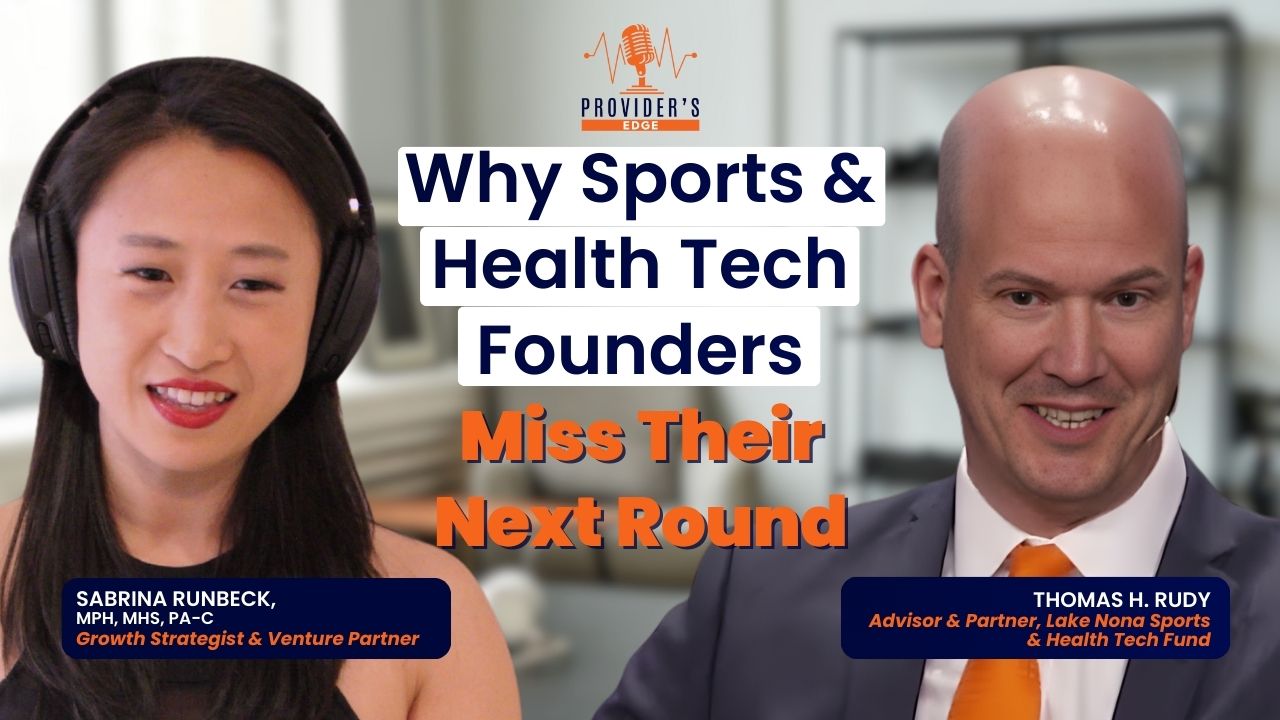
Why does this keep happening to strong HealthTech founders?
You walk into the meeting prepared. The demo works. The mission resonates. The investor nods along and even says the words every founder hopes to hear:
“This is really interesting.”
Then comes the follow-up email.
“We’ve decided not to move forward at this time.”
No clear explanation. No obvious red flags. Just another quiet “no.”
For HealthTech founders, this moment is especially frustrating because the work behind the product is real—clinical insight, regulatory navigation, and deep domain expertise. Yet rejection keeps happening.
Here’s the hard truth most founders don’t hear clearly enough:
Investors aren’t rejecting your idea. They’re rejecting unresolved risk.
And until you understand which risk they see—and why—they’ll keep passing, even when they believe in the mission.
What are investors actually evaluating if not the idea?
In today’s HealthTech market, ideas and vision are table stakes. Investors see thousands of AI-enabled diagnostics, digital therapeutics, remote monitoring platforms, and care-delivery innovations every year.
What differentiates fundable companies isn’t novelty. It’s execution readiness.
Thomas Rudy, Chief Investment Officer at LeAD, explains it plainly:
“We’re willing to take risk on a disruptive model—but not on a team that can’t execute.”
That single sentence captures the shift many founders miss.
Investors expect uncertainty. They do not expect founders to still be unclear about how capital reduces risk.
What does “no traction” really mean in HealthTech?
When investors say you lack traction, they’re rarely talking only about revenue.
In HealthTech, traction is interpreted through a much broader lens:
- Do you understand your buyer’s decision-making process?
- Can you navigate long hospital or enterprise sales cycles?
- Have you moved beyond pilots into repeatable motion?
- Is there proof that adoption can scale without heroic effort?
Clinical validation matters—but it’s not enough on its own. A clinically sound product with no clear commercialization path still represents significant execution risk.
From the investor’s perspective, the question becomes:
“Does this founder know how to move from proof to system?”
If the answer isn’t clear, the default decision is to pass.
Why “we’ll figure it out” erodes investor trust
Many founders believe fundraising is a collaborative process—one where investors will help them figure things out after the check clears.
That belief is one of the most common reasons promising HealthTech startups fail to raise.
Capital is not a clarity-finding tool. It’s a scaling accelerant.
When founders say—or imply—“we’ll figure it out together,” investors hear:
- The business model is still being discovered
- Key execution risks haven’t been owned yet
- Leadership maturity hasn’t caught up to ambition
This doesn’t signal openness. It signals dependency.
And dependency is the opposite of what venture investors are underwriting.
What execution risk looks like behind the scenes
Execution risk isn’t always obvious to founders, but it’s highly visible to experienced investors.
It shows up when:
- KPIs exist but aren’t tied to decisions
- Pilots don’t have a defined path to conversion
- Boards exist in title but not in action
- No one is clearly accountable for outcomes
- The founder is carrying too much alone
As Sabrina Runbeck, host of Health Tech Growth, puts it:
“It’s not just about having support—it’s about having valuable support. If no one’s accountable to outcomes, you don’t have a team. You have titles.”
Investors don’t just fund people. They fund systems that can function under pressure.
Why good HealthTech companies still get passed on
One of the most painful realizations for founders is that rejection doesn’t always mean failure.
Many HealthTech startups that investors pass on:
- Will generate real revenue
- Will serve meaningful patient populations
- Will become sustainable businesses
They’re just not structured for venture capital.
Thomas Rudy is explicit about this distinction:
“Most of the companies we pass on aren't bad. They just aren’t scalable enough to justify venture money.”
Venture capital follows a specific return profile. Investors reverse-engineer outcomes based on:
- Revenue growth trajectories
- Industry valuation multiples
- Profitability potential
- Exit timelines
If a founder can’t clearly connect today’s operations to a plausible venture-scale outcome, the company may still succeed—but not with VC backing.
Discovery mode vs. leadership mode
Early-stage founders are, by nature, explorers. Discovery is part of the job.
But there’s a critical transition point investors look for:
Has this founder moved from discovering the business to leading it?
Signs a founder is still in discovery mode:
- Key decisions are deferred instead of owned
- Metrics are described conceptually, not operationally
- Execution depends on future hires that don’t exist yet
- The story changes from meeting to meeting
Leadership mode doesn’t require having all the answers.
It requires demonstrating:
- Clear ownership of known risks
- A plan to address unknowns
- The ability to make decisions with incomplete information
That’s what investors bet on.
How HealthTech founders should reframe fundraising
Instead of asking:
“Why don’t investors believe in my idea?”
Ask:
“Which risks have I already reduced—and which ones am I still asking investors to absorb?”
This shift changes everything.
When founders lead with a coherent risk narrative:
- Investor conversations become more specific
- Feedback becomes actionable instead of vague
- Alignment replaces guesswork
- Fundraising feels less personal—and more strategic
You stop pitching possibility and start demonstrating readiness.
What investors want to see before they say yes
While no two investors are identical, most HealthTech VCs want evidence of the same underlying capabilities:
- Execution clarity: clear priorities, metrics, and ownership
- Commercial realism: honest understanding of sales cycles and adoption friction
- Team readiness: leadership capacity that matches the challenge
- Scalability logic: a believable path from today to venture-scale outcomes
None of these require perfection.
They require intentionality.
Final takeaway: strong products don’t get funded—strong risk narratives do
HealthTech founders who raise capital aren’t the ones with the boldest vision.
They’re the ones who show they’ve already built the foundation for execution.
Because success isn’t about grinding alone.
As Sabrina Runbeck reminds founders:
“Success isn’t about grinding alone—it’s about knowing how to build the system, the team, and the community who will champion you forward.”
When investors can see that system clearly, capital becomes a catalyst—not a gamble.
And that’s when conversations finally change.
If this resonated, the next step isn’t pitching harder—it’s building clarity where investors need it most.
Relevant Resources
Ep 130- Why Most HealthTech Solutions Fail: The Hidden Gap Between Innovation and Implementation – This episode digs into the common pitfalls that healthtech founders face (particularly in scaling and market fit).
Ep 154- Is Your Startup Built on Swiss Cheese? with George Pappas – A strong fit because it explores structural weaknesses in startups (teams, roles, funding) that align directly with what we unpacked with MyPhuong.
Ep 177- What Traction Signals Investors Say Yes To – Especially relevant for founders looking for their first backers, this episode zeroes in on what investors are actually looking for.
About This Series
This article is part of PulsePoint Path’s Financial Leadership for Healthcare Founders series, dedicated to helping clinician-entrepreneurs build scalable, resilient companies.
Here are 3 ways we can support you right now:
🎤Be a Featured Guest on the Provider’s Edge
Have traction and a story to share? Apply to join us on the show: PulsePointPath.com/Call-Sabrina
🎯 Get You In Front of Investors
We match you with the most aligned investors and decision-makers who care about your niche already. Apply at CapitalEngine.vc
📊 Need clarity on finding your ideal co-founder or executive advisory board?
Let’s create your people-powered growth blueprint in under 6 hours 👉PulsePointPath.com/Leadership-Maximizer
About Sabrina Runbeck
Sabrina Runbeck, MPH, MHS, PA-C helps healthcare technology companies scale sustainably without burning out their teams or running out of cash. She is the Co-Founder of PulsePoint Path and works alongside an integrated 12-member board of advisors to help founders make strategic decisions that multiply impact and protect capital. Her signature 5D Integrated System helps companies move beyond one-dimensional problem solving what they think the issue is and instead, builds an Empowered Ecosystem across leadership, team dynamics, and system alignment. This is how founders evolve from early traction to 10x growth. Sabrina is also a TEDx speaker, former Cardiothoracic Surgery PA, and trusted advisor with over 15 years of experience in public health, neuroscience, and business acceleration.
★ NEXT STEP ★
Book an alignment call to see how we might support you: PulsePointPath.com/Call
Recommended Podcast Episodes
Be a guest on our show
The Provider's Edge show is always looking to feature healthcare change-makers and celebrate the work they are doing to improve healthcare.
Together, we can encourage other healthcare entrepreneurs and startup founders to up-level their businesses.
If you or someone you know could be a good fit as a guest on the show, please click on the bottom below to apply as a speaker.
Healthcare Entrepreneurs!
I can help you gain visibility and credibility in the right circles so you can accelerate your mission and profitability!
After overcoming burnout working in surgery, I went back to my roots in neuroscience and public health. I learned the importance of building key human relationships with my team throughout our organization.
While helping healthcare executives and entrepreneurs to get out of the day-to-day operation of their practice, I realized I needed more visibility and more connections to reach my ideal clients.
Once I set out to be highly visible in the right circles, I was able to leverage my network of strategic partners to convert clients 5x higher than any other marketing channel I had tried previously.
Now I help healthcare change-makers to accelerate their impact and increase profitability by gaining visibility and credibility with the right strategic partners.
My clients no longer worry about where their next client is coming from, the need to plan additional budget for ads spending, or losing the ability to connect with others because their social media account is shut down.
If you want to share your social mission with the world and gain pivotal supporters that become loyal clients... then you are in the right place, with the right consultant who is also a recovered clinician.