
What Signals Tell Investors a HealthTech Company
Is Built for the Long Term?
Investors look for long-term healthtech winners by evaluating team evolution, defensible IP, clinical validation, and the company’s capacity to navigate regulation without sacrificing momentum.
Listen anywhere you get your podcastin' on.


Live Interview
Walk the floor at HLTH and you’ll see it everywhere.
Breakthrough sensors.
Elegant diagnostics.
Clinically sound innovations backed by years of research.
And yet, most of these companies will never raise the round they’re aiming for, let alone scale.
Not because the technology isn’t impressive.
But because investors are quietly evaluating something else entirely:
Is this team actually ready to lead a medical device company to market?
The Question Investors Are Asking (That Founders Rarely Hear)
Founders often believe the funding conversation hinges on novelty:
- Is the IP defensible?
- Is the science sound?
- Is the technology differentiated?
From the investor side, those are entry requirements, not decision drivers.
What they’re really assessing is risk, and in MedTech, risk lives far beyond the lab.
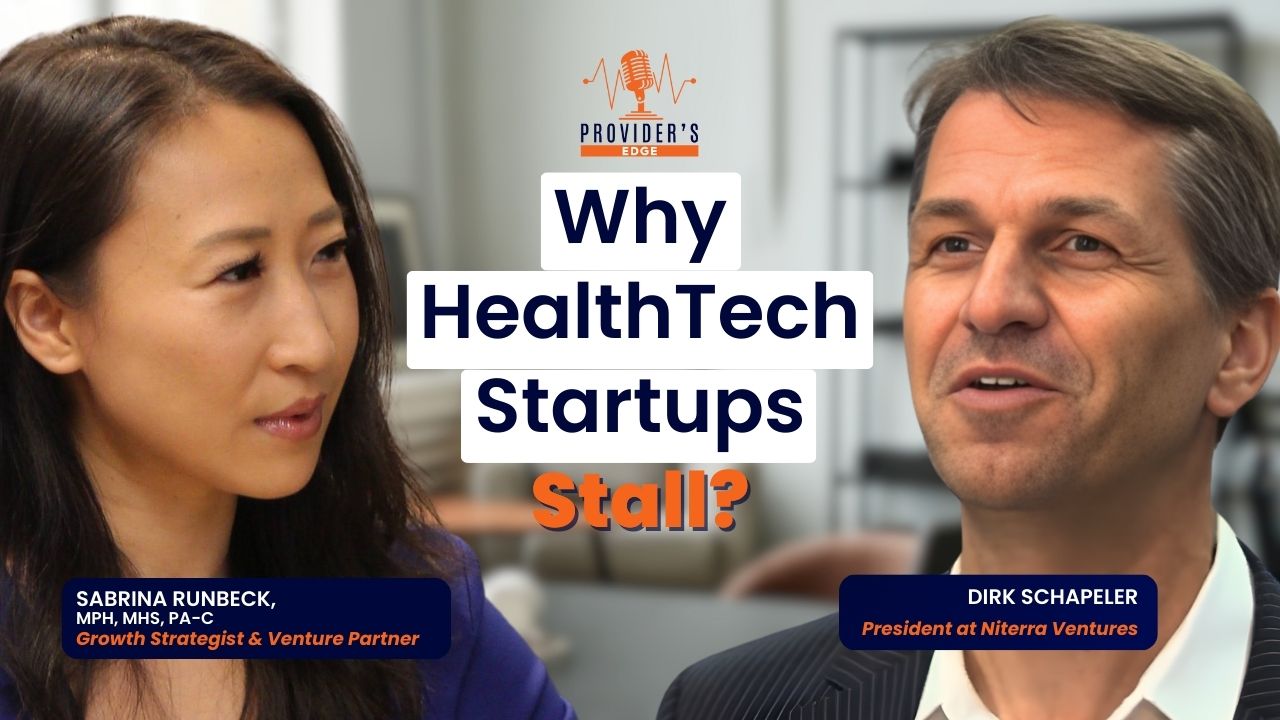
During my conversation with Dirk Schapeler, corporate venture investor at Niterra Ventures, one point came up repeatedly:
“A lot of companies die because they don’t truly understand the unmet need they’re solving.”
— Dirk Schapeler
That statement isn’t about weak science.
It’s about weak translation from innovation to impact.
Why “Great Tech” Is No Longer a Differentiator
Investors today are saturated with technically strong MedTech startups.
They can walk down one conference hall and see:
- Five wound-care solutions
- Seven sensor platforms
- A dozen diagnostics claiming earlier detection
What separates fundable from forgettable isn’t how advanced the technology is, it’s how well the team understands:
- Where cost is leaking in the system
- Who actually feels the pain
- How adoption changes workflow
- Why this solution matters now, not someday
This is why investors spend so much time probing hospital economics, reimbursement, and real-world usage. If founders can’t connect innovation to system-level relief, the perceived risk skyrockets.
The Leadership Gap Investors See Immediately
One of the most common patterns investors encounter is this:
Extraordinary inventors building companies that require extraordinary operators without having any.
This shows up as:
- Founder teams dominated by visionaries
- Limited ownership of regulatory and quality execution
- No clear commercialization leader
- An assumption that leadership gaps can be “fixed later”
From the investor’s perspective, this isn’t a future problem.
It’s a present one.
As we discussed in the interview:
“You can’t scale a healthcare company with only visionaries. You need implementers and operators just as much.”
— Sabrina Runbeck
That’s not an insult to innovation.
It’s a recognition of reality.
Why PhD-Led and Clinician-Founded Startups Hit a Wall
Investors deeply respect scientific and clinical founders. Many of the most promising MedTech breakthroughs come from them.
But respect doesn’t eliminate risk.
The pattern investors worry about looks like this:
- Founders excel at discovery
- The company grows beyond their execution skill set
- Leadership resists evolution
- Scaling stalls
At some point, building the device and building the company become two different jobs. Investors are watching closely to see whether founders recognize that moment or fight it.
Regulatory Approval Isn’t the Finish Line Investors Think You’re Running Toward
Another misconception founders carry is that FDA clearance equals safety in the eyes of investors.
It doesn’t.
Regulatory approval is expected.
What investors want to understand is what happens after.
- Who drives commercialization?
- How does this fit into existing care pathways?
- What does reimbursement actually look like?
- How long before this reduces cost, not just risk?
Investors aren’t scared of regulation itself; they’re cautious about teams that treat it as the only hurdle.
Why Partnerships Matter More Than Perfection
No MedTech company succeeds alone anymore.
The most compelling signal investors look for is systems thinking:
- Combining technologies instead of competing in silos
- Pulling in manufacturing expertise early
- Involving clinical, regulatory, and operational advisors before they’re “needed”
As Dirk put it:
“There is no company that can do this all. It’s all about partnerships.”
Founders who actively build ecosystems signal maturity.
Founders who try to do everything themselves signal fragility.
The Fatal Sequencing Mistake Founders Make
Here’s where many technically strong teams stumble long before the pitch:
They build the product first and validate the problem later.
In healthcare, this is backwards.
By the time you’re raising capital, investors expect to see evidence that you’ve already:
- Spoken with clinicians
- Understood operational constraints
- Tested assumptions about adoption
- Validated that the pain is real and costly
As I shared during the conversation:
“It’s not about building the product first — it’s about selling the problem before you ever build the solution.”
Teams that do this don’t just pitch innovation, they demonstrate relevance.
What “Not Ready” Really Means to Investors
When investors say a MedTech team “isn’t ready,” they’re usually reacting to one of three things:
- Leadership imbalance — too much vision, not enough execution
- Weak understanding of system economics
- No plan for leadership evolution as the company scales
None of these are deal-breakers if addressed early.
But ignoring them turns even world-class technology into unacceptable risk.
The Takeaway for Founders
VCs don’t pass on MedTech startups because the science isn’t exciting.
They pass when the team signals:
- Overreliance on innovation alone
- Underestimation of execution complexity
- Resistance to evolving beyond the inventor phase
Leadership readiness isn’t about replacing founders.
It’s about proving you know how to build a company not just a device.
When investors see that, the conversation changes.
Relevant Resources
Why Most HealthTech Solutions Fail: The Hidden Gap Between Innovation and Implementation – This episode digs into the common pitfalls that healthtech founders face (particularly in scaling and market fit).
Is Your Startup Built on Swiss Cheese? with George Pappas – A strong fit because it explores structural weaknesses in startups (teams, roles, funding) that align directly with what we unpacked with MyPhuong.
What Traction Signals Investors Say Yes To – Especially relevant for founders looking for their first backers, this episode zeroes in on what investors are actually looking for.
About This Series
This article is part of PulsePoint Path’s Financial Leadership for Healthcare Founders series, dedicated to helping clinician-entrepreneurs build scalable, resilient companies.
Here are 3 ways we can support you right now:
🎤Be a Featured Guest on the Provider’s Edge
Have traction and a story to share? Apply to join us on the show: PulsePointPath.com/Call-Sabrina
🎯 Get You In Front of Investors
We match you with the most aligned investors and decision-makers who care about your niche already. Apply at CapitalEngine.vc
📊 Need clarity on finding your ideal co-founder or executive advisory board?
Let’s create your people-powered growth blueprint in under 6 hours 👉PulsePointPath.com/Leadership-Maximizer
About Sabrina Runbeck
Sabrina Runbeck, MPH, MHS, PA-C helps healthcare technology companies scale sustainably without burning out their teams or running out of cash. She is the Co-Founder of PulsePoint Path and works alongside an integrated 12-member board of advisors to help founders make strategic decisions that multiply impact and protect capital. Her signature 5D Integrated System helps companies move beyond one-dimensional problem solving what they think the issue is and instead, builds an Empowered Ecosystem across leadership, team dynamics, and system alignment. This is how founders evolve from early traction to 10x growth. Sabrina is also a TEDx speaker, former Cardiothoracic Surgery PA, and trusted advisor with over 15 years of experience in public health, neuroscience, and business acceleration.
★ NEXT STEP ★
Book an alignment call to see how we might support you: PulsePointPath.com/Call
Recommended Podcast Episodes
Be a guest on our show
The Provider's Edge show is always looking to feature healthcare change-makers and celebrate the work they are doing to improve healthcare.
Together, we can encourage other healthcare entrepreneurs and startup founders to up-level their businesses.
If you or someone you know could be a good fit as a guest on the show, please click on the bottom below to apply as a speaker.
Healthcare Entrepreneurs!
I can help you gain visibility and credibility in the right circles so you can accelerate your mission and profitability!
After overcoming burnout working in surgery, I went back to my roots in neuroscience and public health. I learned the importance of building key human relationships with my team throughout our organization.
While helping healthcare executives and entrepreneurs to get out of the day-to-day operation of their practice, I realized I needed more visibility and more connections to reach my ideal clients.
Once I set out to be highly visible in the right circles, I was able to leverage my network of strategic partners to convert clients 5x higher than any other marketing channel I had tried previously.
Now I help healthcare change-makers to accelerate their impact and increase profitability by gaining visibility and credibility with the right strategic partners.
My clients no longer worry about where their next client is coming from, the need to plan additional budget for ads spending, or losing the ability to connect with others because their social media account is shut down.
If you want to share your social mission with the world and gain pivotal supporters that become loyal clients... then you are in the right place, with the right consultant who is also a recovered clinician.