
The Hidden Hiring Risks
That Derail Fundraising Rounds
Most founders assume investors evaluate teams the same way LinkedIn does: credentials, prior logos, titles, and who’s been backed before.
But when you listen closely to how experienced investors actually talk especially in HealthTech and FemTech you hear something very different.
Because long before an investor debates valuation or term sheets, they’re asking a quieter, far more consequential question:
“Can these humans actually build together when things don’t go as planned?”
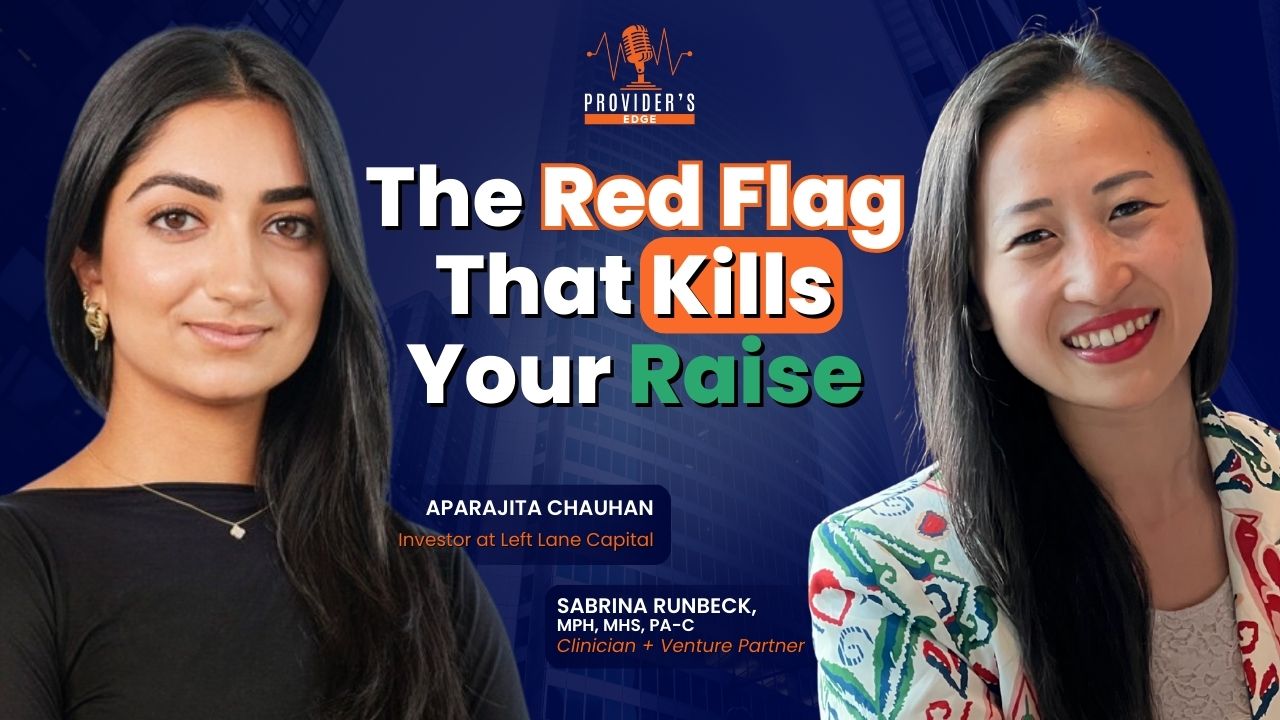
This article breaks down what investors are really evaluating when they look at founding teams, drawing directly from investor conversations including insights shared by Aparajita Chauhan and from years of working with founders navigating high-stakes growth and capital decisions.
Listen anywhere you get your podcastin' on.


Live Interview
Why Human Capital Is the Hardest Risk to Underwrite
Early-stage investing is fundamentally risk management. Market risk. Product risk. Execution risk.
But the hardest risk to evaluate and the one most often underestimated is human capital risk.
As Aparajita Chauhan put it plainly:
“You’re investing in human beings. Businesses don’t run themselves—people do.”
This is why teams that look flawless on paper sometimes fail to inspire conviction in the room. Investors have seen too many companies stall not because the idea was wrong, but because the people couldn’t execute together under pressure.
They’ve seen:
- Co-founders who agree publicly but undermine each other privately
- Leadership teams that avoid hard conversations
- Founders who perform confidence instead of practicing clarity
From the outside, everything looks impressive. Inside, friction quietly compounds.
Why Resumes Matter Less the Longer the Conversation Goes
Credentials still matter but mostly at the very beginning.
They open the door.
Once that door is open, investor evaluation shifts quickly from who you are to how you operate.
Questions investors are silently answering include:
- How are decisions actually made?
- Who owns what when priorities collide?
- How does this team handle missed targets?
- What happens when pressure increases instead of praise?
Aparajita noted that some of the most disappointing outcomes come from teams with exceptional pedigrees but poor working dynamics. That gap between appearance and execution is where investor confidence erodes.
This is why investors increasingly prioritize operating behavior over operating history.
The Founding Journey Is Not Linear and Investors Don’t Expect It to Be
There’s a persistent myth in startup culture that great teams move “up and to the right.”
Experienced investors know that’s fiction.
They expect:
- Strategy pivots
- Missed milestones
- Market shifts
- Internal tension
What they don’t tolerate is denial.
Instead of perfection, investors look for:
- Self-awareness
- Accountability
- Learning velocity
- Mutual respect during stress
As Aparajita described, a big part of team evaluation is asking:
Are these people we can work with when things are hard—not just when things are exciting?
That’s not about likability. It’s about durability.
Why Big Names Don’t Compensate for Misalignment
One of the most common founder miscalculations is assuming that adding high-profile advisors, executives, or board members will compensate for internal misalignment.
It doesn’t.
In fact, it can amplify risk.
When investors see a team full of accolades but struggling to communicate or execute, it raises a red flag: if collaboration is hard now, it will be harder later.
This is where internal clarity becomes as important as external storytelling.
As PulsePoint Path founder Sabrina Runbeck observes:
“So many companies talk high-level pain points but still operate like they’re throwing spaghetti at the wall instead of tracking what actually works.”
That insight applies as much to leadership as it does to go-to-market strategy. Teams that can articulate how they work together signal maturity. Teams that can’t often signal risk.
What Investors Are Actually Looking For in Founding Teams
Across conversations with institutional investors, several consistent evaluation patterns emerge.
1. Decision Ownership
Who decides what—and how quickly? Diffuse authority slows companies down and creates friction investors can feel.
2. Communication Under Pressure
If communication breaks with five people, it won’t survive fifty.
3. Mutual Respect
Not performative alignment, but real respect when opinions diverge.
4. Coachability Without Fragility
The ability to absorb hard feedback without defensiveness—or whiplash pivots.
5. Consistency Over Time
This is why updates matter.
As Aparajita shared:
“I love getting updates and seeing founders exceed expectations. That’s when we know we’re ready to talk again.”
Progress builds trust. Consistency compounds it.
Why This Evaluation Starts Earlier Than Founders Realize
Many founders believe team evaluation begins once fundraising officially starts.
In reality, it begins the moment a relationship begins.
Early conversations and updates allow investors to observe:
- How founders frame wins and misses
- Whether narratives evolve with evidence
- How leadership maturity develops over time
This is particularly important for women-led HealthTech and FemTech companies, where founders often feel pressure to over-prove credibility.
The truth is: clarity builds confidence faster than over-explaining ever will.
And that includes being willing to say no.
As Sabrina Runbeck puts it:
“We need to be okay saying no to advisors or investors who don’t see our vision—alignment is more important than validation.”
Investors feel that clarity. And they trust it.
The Real Takeaway for Founders
Investors aren’t just backing an idea. They’re backing a group of humans they may work with for a decade.
Your job isn’t to look perfect.
It’s to demonstrate:
- How you lead
- How you collaborate
- How you learn
- And how you operate when plans change
Because long after the pitch deck is closed, that is what determines whether a partnership works.
And it’s what separates teams that generate interest from teams that earn conviction.
About PulsePoint Path
PulsePoint Path partners with founders and investors in HealthTech, FemTech, and innovation-driven companies to build clarity, alignment, and decision-ready growth. Our work focuses on the human, strategic, and operational infrastructure that capital alone can’t fix.
If this article resonated, the next question isn’t whether your team looks impressive—it’s whether it operates with the clarity and alignment investors quietly look for.
Here are 3 ways we can support you right now:
🎤Be a Featured Guest on the Provider’s Edge
Have traction and a story to share? Apply to join us on the show: PulsePointPath.com/Call-Sabrina
🎯 Get You In Front of Investors
We match you with the most aligned investors and decision-makers who care about your niche already. Apply at CapitalEngine.vc
📊 Need clarity on finding your ideal co-founder or executive advisory board?
Let’s create your people-powered growth blueprint in under 6 hours 👉PulsePointPath.com/Leadership-Maximizer
About Sabrina Runbeck
Sabrina Runbeck, MPH, MHS, PA-C helps healthcare technology companies scale sustainably without burning out their teams or running out of cash. She is the Co-Founder of PulsePoint Path and works alongside an integrated 12-member board of advisors to help founders make strategic decisions that multiply impact and protect capital. Her signature 5D Integrated System helps companies move beyond one-dimensional problem solving what they think the issue is and instead, builds an Empowered Ecosystem across leadership, team dynamics, and system alignment. This is how founders evolve from early traction to 10x growth. Sabrina is also a TEDx speaker, former Cardiothoracic Surgery PA, and trusted advisor with over 15 years of experience in public health, neuroscience, and business acceleration.
★ NEXT STEP ★
Book an alignment call to see how we might support you: PulsePointPath.com/Call
Recommended Podcast Episodes
Be a guest on our show
The Provider's Edge show is always looking to feature healthcare change-makers and celebrate the work they are doing to improve healthcare.
Together, we can encourage other healthcare entrepreneurs and startup founders to up-level their businesses.
If you or someone you know could be a good fit as a guest on the show, please click on the bottom below to apply as a speaker.
Healthcare Entrepreneurs!
I can help you gain visibility and credibility in the right circles so you can accelerate your mission and profitability!
After overcoming burnout working in surgery, I went back to my roots in neuroscience and public health. I learned the importance of building key human relationships with my team throughout our organization.
While helping healthcare executives and entrepreneurs to get out of the day-to-day operation of their practice, I realized I needed more visibility and more connections to reach my ideal clients.
Once I set out to be highly visible in the right circles, I was able to leverage my network of strategic partners to convert clients 5x higher than any other marketing channel I had tried previously.
Now I help healthcare change-makers to accelerate their impact and increase profitability by gaining visibility and credibility with the right strategic partners.
My clients no longer worry about where their next client is coming from, the need to plan additional budget for ads spending, or losing the ability to connect with others because their social media account is shut down.
If you want to share your social mission with the world and gain pivotal supporters that become loyal clients... then you are in the right place, with the right consultant who is also a recovered clinician.